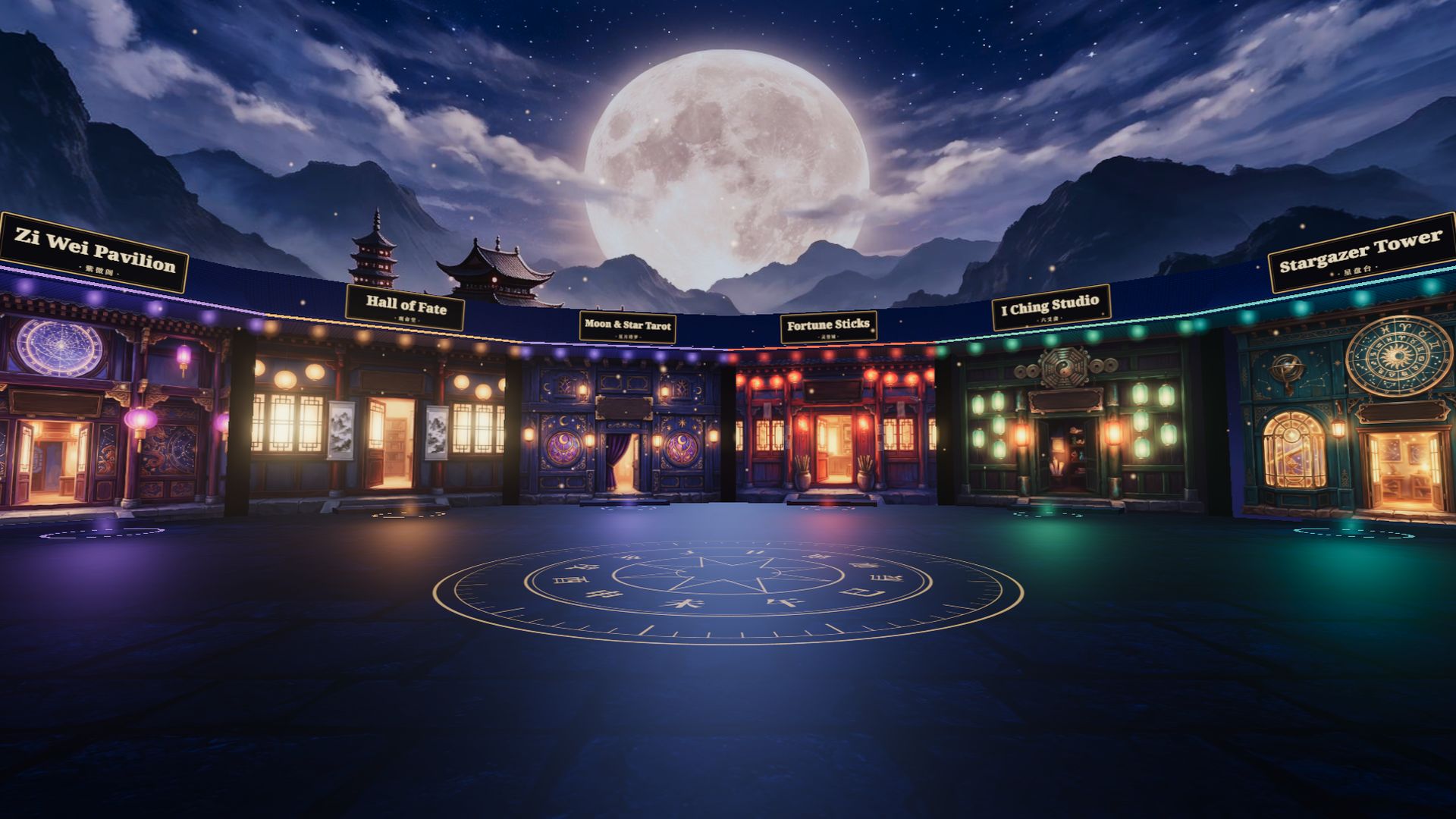
A Zi Wei Dou Shu chart is a ring of twelve palaces, each covering one area of life. Start with the Life Palace and its main stars. Then read its triangle – the Wealth, Career and Travel palaces – and see where your birth year's Four Transformations land. Finally, use the ten-year periods to see which palace is in focus at each stage of life.
What the chart looks like
The twelve palaces sit in a ring, one for each Earthly Branch, starting with Yin at the bottom left and running clockwise to Chou. The palaces are Life, Siblings, Spouse, Children, Wealth, Health, Travel, Friends, Career, Property, Well-being and Parents. Each covers one area. Career is your work path, for example, Wealth your relationship with money, and Well-being your inner contentment and pleasures.
The palaces hold stars. The most important are the fourteen main stars: Zi Wei, Tian Ji, Tai Yang, Wu Qu, Tian Tong, Lian Zhen, Tian Fu, Tai Yin, Tan Lang, Ju Men, Tian Xiang, Tian Liang, Qi Sha and Po Jun. Each is often marked with a brightness grade. From strongest to weakest: Temple (庙 miao), Prosperous (旺 wang), Favorable (得 de), Beneficial (利 li), Neutral (平 ping), Unfavorable (不 bu), Fallen (陷 xian). A brighter star expresses its nature more easily.
Step 1: The Life Palace and its stars
We'll use a real chart: a woman born May 20, 1990 at 14:30 (the Wei hour). The Zi Wei Pavilion places her Life Palace in Xu, with Tian Ji (li) and Tian Liang (miao) together. Her Body Palace is Well-being, in Zi. Her Five Elements Bureau is Earth 5, so her first ten-year period starts at age 5. Her Life Ruler is Lu Cun and her Body Ruler is Huo Xing.
Tian Ji is the star of thinking, strategy and adaptability. Tian Liang is the star of caretaking, principle and an elder's steadiness. Together in the Life Palace they are often described as a quick, analytical mind that enjoys advising others. Read paired stars as one combination rather than two separate personalities.
Step 2: The three-sided, four-cornered view
No palace is read alone. The Life Palace works together with the two palaces that form a triangle with it – Wealth and Career – and the palace directly opposite, Travel. Those four set the basic pattern. For a Life Palace in Xu, Wealth is in Wu, Career in Yin and Travel in Chen.
In the example, Wealth holds Tian Tong (xian) and Tai Yin (bu), while Career and Travel are empty – no main stars. An empty palace is not a void. Traditionally it borrows the main stars of the opposite palace. Career in Yin borrows Tai Yang and Ju Men from Shen, and Travel in Chen borrows Tian Ji and Tian Liang from the Life Palace. So her Career Palace reads with Tai Yang and Ju Men flavor: work that involves speaking, explaining or a public voice.
Step 3: The Four Transformations
The Four Transformations, or Four Hua – Hua Lu, Hua Quan, Hua Ke and Hua Ji – come from the Heavenly Stem of your birth year. They stand for flow and resources, power and capability, reputation and helpful people, and fixation or a life lesson. 1990 is a Geng year. The Pavilion uses Tai Yang Hua Lu, Wu Qu Hua Quan, Tai Yin Hua Ke and Tian Tong Hua Ji. Geng is the year schools disagree on most, and this chart follows the default of iztro, the open-source library the Pavilion uses.
On the chart, Hua Lu lands in the Spouse Palace (Tai Yang) and Hua Quan in Children (Wu Qu), and both Hua Ke and Hua Ji fall in Wealth (Tai Yin and Tian Tong). Roughly: partners are a source of support. The Children Palace, which also covers partnerships and creative work, carries real capability. With money she values order and reputation but tends to agonize over spending and saving. Hua Ji marks where more care is needed, not a disaster.
Step 4: Ten-year periods
Each palace governs a ten-year period, shown as an age range in every cell at the Zi Wei Pavilion. As a woman born in a yang year, her periods run backward: Life 5–14, Siblings 15–24, Spouse 25–34, Children 35–44, and so on. In 2026 she is 37 by traditional East Asian age reckoning, so she is in the Children period. That palace holds Wu Qu (miao, Hua Quan) and Tan Lang (miao), plus Zuo Fu and You Bi. Treat the active palace as a temporary Life Palace for those ten years and read its triangle the same way.
Common mistakes
Reading only the Life Palace stars. They set the tone, but the triangle and the Four Hua decide how the chart actually works.
Assuming an empty palace is bad. Empty palaces borrow from the opposite side and often read as adaptable.
Seeing Hua Ji as bad luck. It points to an attachment or a lesson, and often to where a person puts in the most effort.
Copying star descriptions wholesale. The same star changes a lot with its palace, brightness and companions. Descriptions are only a starting point.
Casting a chart at the Zi Wei Pavilion
Mo Yan asks for your Gregorian birth date, time and sex. Press Cast and the twelve palaces turn into a ring in the 3D pavilion. The result panel is a twelve-palace grid. Each cell shows the palace name, main stars with brightness, transformations, minor stars, the palace's Stem and Branch, and its ten-year age range. The center shows the Five Elements Bureau, the Chinese date and the Life and Body Rulers. Life Palace stars link to the star dictionary. Star names are shown in pinyin.
The AI quick reading is free. The full reading and topic reports on career, love, wealth and the year ahead cost points, and you can compare two charts with Zi Wei compatibility. Birth time matters more here than anywhere else. Without it, treat the Life Palace as a rough guide.
FAQ
What is the difference between Zi Wei Dou Shu and BaZi?
Both use your birth date and hour. BaZi turns them into eight Stems and Branches and reads the Five Elements. Zi Wei places stars into twelve life-area palaces. Zi Wei is more sensitive to birth time and maps more directly onto specific areas of life.
My Life Palace is empty. How do I read it?
Borrow the main stars of the opposite palace (Travel) and read the Wealth and Career palaces alongside. An empty Life Palace is often described as adaptable and more shaped by surroundings and the current ten-year period.
Can I cast Zi Wei Dou Shu without a birth time?
You can, but the Life Palace is set by birth month and hour, so a different hour rotates the whole chart. The Pavilion uses noon when the time is unknown, and the result should be treated as approximate.
Is Zi Wei Dou Shu accurate?
Star placement is a fixed calculation (the Pavilion uses the open-source iztro library). The interpretation follows traditional star meanings and the Four Hua, explained by AI in plain English. It is for entertainment and self-reflection only.
Further reading
More guides
This article was compiled by AI from FateTown’s own chart rules and data. For entertainment and self-reflection only. · Updated 2026-11-23