Fortune Sticks
Chinese Fortune Sticks Online: Shake a Kau Cim
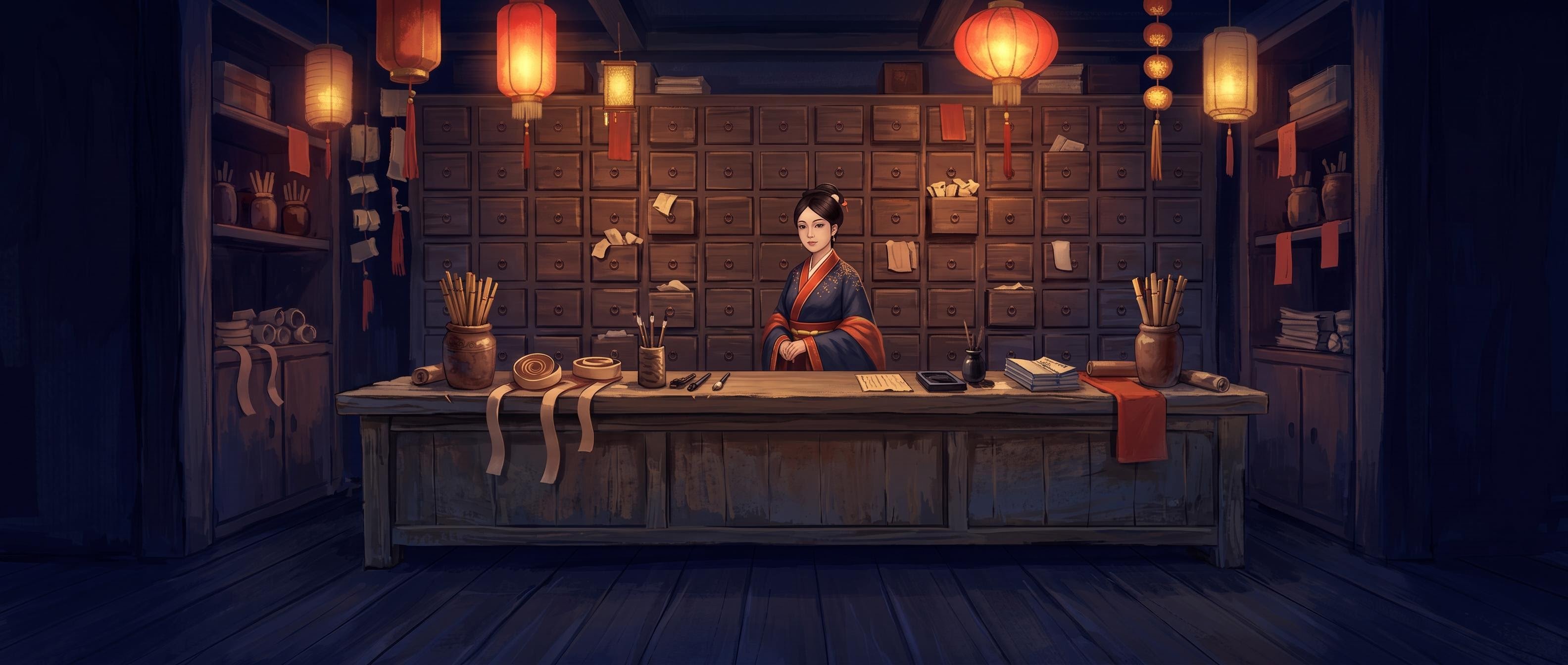
Welcome to Fortune Sticks — I'm A-Yuan. Keep the thing you want to ask about in mind, then give the cup a shake. Whichever stick falls out is yours.
About
What are Chinese fortune sticks?
Chinese fortune sticks, known in Cantonese as kau cim (求籤, “asking for a stick”), are a folk custom found wherever Chinese communities live. You hold a question in mind and shake a bamboo cylinder full of numbered sticks, tilting it until one stick works its way out and falls. The number on that stick leads to a short poem, and the poem is read as a comment on your question.
The poems are the heart of the practice. They are written in four lines of seven characters, full of images: a boat waiting for the tide, clouds clearing from the moon, a road through the mountains. They rarely say “yes” or “no”. Instead they describe a situation and an attitude, and the reader works out how it applies. That is why fortune sticks have always come with an explanation.
The Fortune Sticks shop in FateTown is a small folk-style stall with a set of 100 sticks written for this site. Each one has its own number, a grade, a title, a four-line poem, a one-line summary, and brief notes for six areas of life. It is a cultural pastime, presented for entertainment and self-reflection, and it is not connected to any religious site or tradition.
Because the poems are in classical-style Chinese, the English page gives the verse in English with the original in a small line beneath it, plus an English title, summary and topic notes. A-Yuan, the stall keeper, then explains the stick in plain English and relates it to your question. A short explanation is free.
Reading the result
How to read your fortune stick
Every stick in the cup has the same parts. Here is what each one tells you.
- The number
- Sticks are numbered 1 to 100. The number is simply the stick's address; it carries no meaning of its own. You can look up any number on the list of all 100 sticks.
- The grade
- Each stick has one of seven grades, from Supreme (上上) through Very good, Good, Fairly good, Neutral and Modest to Challenging (下下). Of the 100 sticks, 12 are Supreme and 6 are Challenging; the rest sit in between.
- The title
- Four Chinese characters that sum up the image of the poem, such as “Clouds Part, the Moon Appears” for stick No. 1. It is the quickest way to remember a stick.
- The poem
- Four lines, seven characters each. Read it as a scene: what is happening, what is about to change, and what the poem advises you to do. The English page shows an English rendering, with the original Chinese in a small line below.
- The summary
- One or two sentences in plain language that say what the stick is pointing at right now, for example “the obstacles of the past are clearing”.
- The six topics
- Short notes for career, love, money, travel, exams and lost items. If your question fits one of them, start there; the other five give context.
- A low grade is a warning, not a sentence
- Modest and Challenging sticks usually say “slow down”, “wait for a better moment” or “protect what you have”. Read them as practical advice about timing, not as bad luck that has been decided.
- Asking again
- The old custom is one question, one stick. If you shake again straight away for the same question, you are really asking a different question: “will I get a better answer?” Give the first stick a fair hearing first.
What is different here
What makes this fortune stick shop different
The set is original. Our 100 sticks were written for FateTown in the style of traditional folk verse, with a consistent structure and six topic notes for every stick, so the result is never a scrap of poem without context.
The result is fixed before it is explained. Your stick is chosen the moment you shake. The server looks up the poem and notes for that number, and the AI is told to explain that stick and not to change its grade or meaning.
It feels like a real stall. You shake a bamboo cup in a lantern-lit 3D room, or shake your actual phone, and the stick tumbles out in front of you. Each shop also shows a line from the Town notice, such as how many sticks were drawn in town today.
Related readings
More to explore
Look up every stick, or try another way of asking.
- All 100 fortune sticksEvery poem with its grade, summary and topic notes.
- Chinese almanacWhat the traditional calendar lists as good and bad for today.
- I Ching coin readingToss three coins six times for a hexagram on your question.
- Guide: how to read fortune sticksAsking a good question and reading the poem line by line.
What does kau cim mean?
Kau cim is Cantonese for “asking for a stick” (求籤, qiu qian in Mandarin). It names the whole custom of shaking a cup of numbered sticks and reading the poem that matches the one that falls. You may also see it called chien tung, after the bamboo cup.
Is it free?
Yes. Shaking the cup, the poem, the topic notes and A-Yuan's short explanation are free within a daily allowance: guests get a few each day, signing in gives you more, and members get more again by tier. A fuller reading with follow-up questions uses points.
Are the fortune sticks accurate?
The stick is random and its poem is fixed, so there is nothing to tune. How it fits your situation is a matter of reflection. We offer it for entertainment and self-exploration, not as a prediction.
I drew a Challenging stick. Should I worry?
No. Low grades are rare (6 out of 100) and almost always about timing: hold off, avoid forcing things, look after what you already have. Read the topic note for your area and see whether it is useful advice.
Can I shake again if I don't like the result?
You can, the shop doesn't stop you. Traditionally, though, one question gets one stick. If you ask again, try changing the question rather than repeating it.
Can I read the poem in English?
Yes. The verse is written in classical-style Chinese and loses some of its rhythm in translation, so the English rendering comes with the original in a small line below it. The title, summary and six topic notes are in English, and the AI explanation unpacks the imagery.
Are these the same poems I'd find elsewhere?
No. This set of 100 was written for FateTown. The structure (number, grade, four-line poem, topic notes) follows the folk tradition, but the poems are our own.
How do I shake with my phone?
Open the shop on your phone and give it a firm shake. iPhones ask for permission to use motion sensors the first time; if you decline, just tap the cup instead.
What can I ask about?
Anything you are turning over: work, love, money, a trip, an exam, something you've lost. Health, legal and investment decisions need a qualified professional; the sticks are not a substitute.
Who is A-Yuan?
A-Yuan is the young keeper of the Fortune Sticks stall, a character in FateTown. The stick is drawn by software and her explanations are written by AI.
Other shops in town