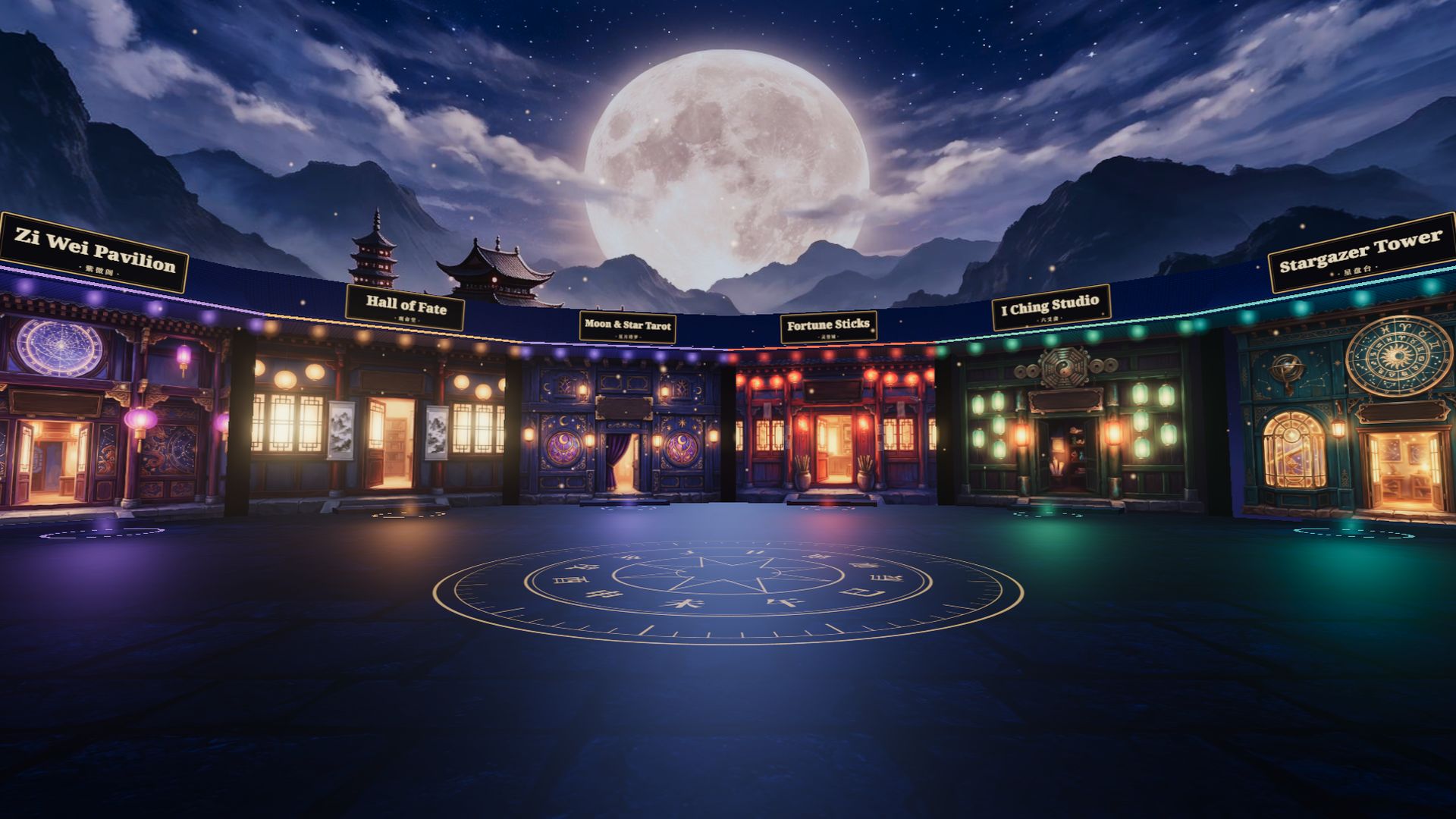
Read a fortune stick in three steps. Check the grade for the general direction. Read the four-line poem to see what situation it describes and what it advises. Then look at the note for the area you asked about: career, love, money, travel, exams or lost items. A stick works like a mirror that points at what to watch for. It isn't a verdict.
What's on a stick
Every stick at the Fortune Sticks shop has a number from 1 to 100, a four-character title such as ‘Clouds Part, the Moon Appears’ or ‘Flowers Seen Through Mist’, a grade, a four-line poem of seven characters per line, a one-sentence hint, and short notes on six topics: career, love, money, travel, exams and lost items. All 100 are original folk-style writing, newly composed for FateTown and not taken from any existing set.
There are seven grades. From best to most difficult: Supreme (上上), Very good (上吉), Good (中吉), Fairly good (小吉), Neutral (中平), Modest (下平) and Challenging (下下). Of the 100 sticks, 12 are Supreme, 17 Very good, 17 Good, 16 Fairly good, 17 Neutral, 15 Modest and only 6 Challenging, so most draws land in the middle.
Step 1: The grade gives direction only
The grade tells you whether the wind is behind you or against you, not how things end. A Supreme stick can still warn against getting complacent, and a Challenging one usually just says ‘pause’. Note the grade, then give the poem most of your attention.
Step 2: Read the poem in four beats
Most poems follow the classical four-beat structure. Lines one and two paint a scene that mirrors your situation. Line three turns and gives advice. Line four closes with what follows if you take it.
Take stick 6, ‘Flowers Seen Through Mist’ (Neutral): 花在烟中半有无,近前方识是耶非。劝君且慢轻许诺,待到天明再定归。 Roughly: flowers half-hidden in the haze; only up close can you tell what is real. So don't make promises lightly – wait for daylight, then decide. Lines one and two say the information is incomplete, line three says don't commit yet, and line four says decide once things are clear. The stick's hint says it plainly: ‘You don't have the full picture yet. Hold off on big decisions until things are clear.’
Step 3: Match it to your question
The six topic notes apply the poem to specific areas. For stick 6: Career – ‘Not enough info – don't decide yet’. Love – ‘Don't rush into promises’. Money – ‘Look closely before investing’. Travel – ‘Double-check your route’. Exams – ‘Read each question carefully’. Lost items – ‘You may be misremembering where it is’.
Focus on the note that matches your question and treat the others as background. If you asked whether to accept a business partnership, read the career note, then go back to line three, ‘don't make promises lightly’. The message is clear: get the terms in writing before you agree.
What if you draw a Challenging stick?
Stick 21, ‘Traveling on a Stormy Night’ (Challenging): 夜黑风高路不明,一程泥水一程惊。且寻檐下暂歇脚,天亮方宜再启程。 Roughly: a black, windy night and a road you can't see, mud and alarm at every step; find shelter under the eaves and set out again at dawn. Nothing in it predicts a disaster. It says the road is bad right now, so rest and continue when it's light. The hint: ‘Now is not the time to charge ahead. Seek stability first and wait for things to turn.’ Career says ‘Postpone major decisions’. Travel says ‘Delay travel if you can’.
So treat a Challenging stick as a ‘slow down’ reminder and look at what you can safely put on hold. There's nothing you need to do to undo it, and no reason to redraw straight away for a better one.
Common mistakes
Drawing again and again until you like the result. The first stick is the reading. Redrawing just picks what you wanted to hear.
Reading the grade and skipping the poem. Two Neutral sticks can give opposite advice – ‘take it step by step’ versus ‘wait until you can see clearly’.
Asking something too broad. ‘How will this year go?’ doesn't map onto any of the six topics. A specific question gives a clearer answer.
Treating the stick as fixed fate. It describes where you stand and what to consider. What you do next still shapes the outcome.
Drawing a stick at the Fortune Sticks shop
A-Yuan, the shopkeeper, invites you to type what you're asking about (optional) and press Shake. On a phone you can simply shake the phone itself. The stick is chosen at random the moment the shaking starts, and the 3D animation then plays out that result.
The result panel shows the grade, the stick number and title, the four-line poem, the hint and all six topic notes. The poem is given in English with the original Chinese in a small line beneath it, and the title, hint and notes are in English too. The stick number links to the full list of all 100 fortune stick meanings. The AI quick reading is free and the full reading costs points. The AI only explains the stick you drew. It never swaps it.
FAQ
How many times can I draw for the same question?
Once. Draw again when something has moved on, or after some time has passed and you want a fresh look.
Where do these fortune sticks come from?
They are original folk-culture content written for FateTown. They borrow the traditional form of a seven-character, four-line poem, but every verse is new and none represents any particular organization or place.
Are online fortune sticks accurate?
Which stick you get is random. The reading follows the poem and its notes, and the AI relates them to your question in plain English. It's for entertainment and self-reflection, a way to look at a situation from another angle.
Can I draw without typing a question?
Yes. Without a question, read it as a general note for the near future and focus on the poem and the hint. If something specific is on your mind, typing it in makes the reading more focused.
Further reading
More guides
This article was compiled by AI from FateTown’s own chart rules and data. For entertainment and self-reflection only. · Updated 2026-11-23