I Ching Studio
Free I Ching Reading Online: The Three-Coin Toss
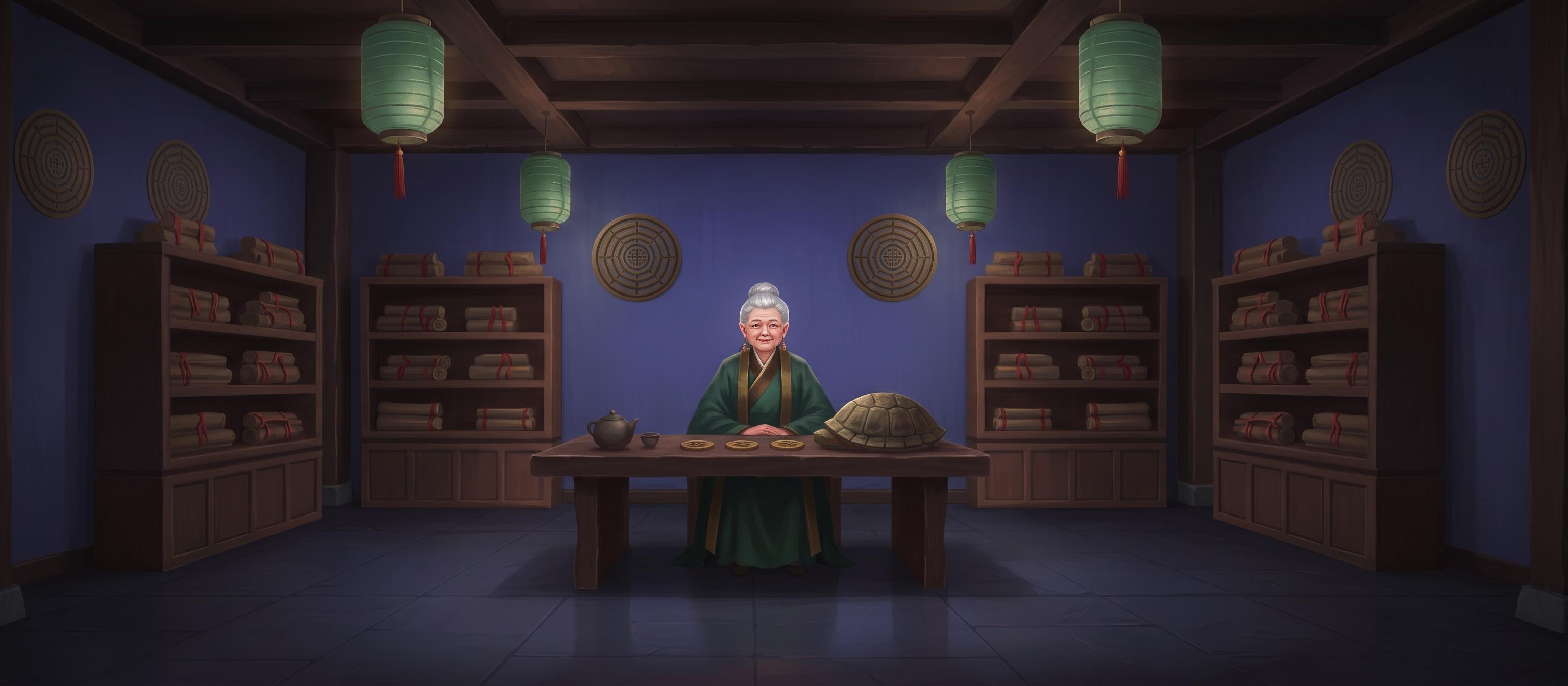
Ah, there you are — sit, sit. I'm Granny Zhou. Keep one question in mind, and toss these three coins six times.
About
What is an I Ching reading?
The I Ching (易经, Yi Jing, the “Book of Changes”) is one of the oldest Chinese classics, more than two and a half thousand years old. At its core are 64 hexagrams: figures of six stacked lines, each line either solid (yang) or broken (yin). Every hexagram has a name, such as Qian, The Creative, or Wei Ji, Before Completion, and a short Judgment text describing a situation and how to meet it.
To consult the I Ching you ask a question and generate six lines by chance, from the bottom up. The three-coin method is the most popular way to do it, and it is the one used in this shop. Some lines come out “old”, meaning they are about to turn into their opposite. Those changing lines are the most important part of the answer, because they show where the situation is moving.
So a reading usually gives two hexagrams: the primary hexagram for where things stand, and the changed hexagram you get by flipping the changing lines, for where they are heading. The I Ching rarely answers in one word. It describes the shape of the moment and suggests an attitude, which is why people keep returning to it for decisions.
The I Ching Studio is run by Granny Zhou, an old hand with the coins. You toss them yourself, she lays out the hexagram, and the AI explains it in plain English in light of your question. The Judgment is shown in plain English, with the classical Chinese original in a small line beneath it. It is offered for entertainment and self-reflection.
Reading the result
How to read your hexagram
A few terms come up in every I Ching reading. Here is what they mean on this page.
- Yin and yang lines
- A solid line is yang: firm, active. A broken line is yin: yielding, receptive. Six of them, read from the bottom up, make a hexagram.
- The three-coin values
- Heads counts 3 and tails 2, so three coins add up to 6, 7, 8 or 9. Seven is young yang and eight is young yin, both stable. Nine is old yang and six is old yin: these are the changing lines.
- Changing lines (动爻)
- An old line is at its limit and turns into its opposite. Changing lines point to the part of the situation that is in motion, and the reading pays most attention to them.
- Primary hexagram (本卦)
- The six lines exactly as you tossed them. It describes the situation as it stands now.
- Changed hexagram (变卦)
- The hexagram you get when every changing line flips. It suggests where things are heading. If you tossed no changing lines, there is no changed hexagram and you read the primary one on its own.
- Trigrams
- Every hexagram is two three-line trigrams stacked: Heaven, Lake, Fire, Thunder, Wind, Water, Mountain or Earth. Their pairing gives the hexagram its image, such as Water over Fire for After Completion.
- The Judgment (卦辞)
- The short classical text attached to each hexagram. It is terse and open to many translations, so the panel gives a plain-English rendering with the original Chinese in a small line below it.
- Many changing lines
- With one or two changing lines, those lines carry the message. With four or more, the situation is in flux and the changed hexagram usually matters more than the starting point.
What is different here
What makes the I Ching Studio different
You do the tossing. Rather than a single “cast” button, you throw the coins six times on a 3D table and watch the hexagram build line by line, the way people have done it for centuries. It works on phone and desktop browsers.
Each toss is fixed the moment you make it, and the server rebuilds the hexagram from your six values before the AI sees anything. The AI is told which hexagram and which lines you got and is asked to explain them, not to choose different ones.
The same shop also offers Plum Blossom Numerology, a method that casts a hexagram from the moment you ask or from two numbers, and every hexagram links to our reference page of all 64, so you can read further on your own.
Related readings
Keep exploring
Another way to cast, all 64 hexagrams, and guides.
- Plum Blossom NumerologyCast a hexagram from the time or two numbers, no coins needed.
- The 64 hexagramsEvery hexagram with its Judgment and a plain-English meaning.
- Chinese fortune sticksShake a cup of 100 sticks and read a four-line poem.
- Guide: the I Ching coin methodHow to toss, record the lines and read the changing ones.
- Guide: Plum Blossom NumerologyThe basics of casting by time and number.
Is this I Ching reading free?
Yes. Tossing the coins, both hexagrams and the short reading are free within a daily allowance: guests get a few each day, signing in gives you more, and members get more again by tier. The full reading and follow-up questions use points.
How does the three-coin method work?
Each toss of three coins gives a number from 6 to 9: heads are worth 3, tails 2. Odd totals make a yang line and even totals a yin line; 6 and 9 are changing lines. Six tosses, from the bottom up, make the hexagram.
What are changing lines?
Lines that came out as old yin (6) or old yang (9). They are about to flip, so they show what is shifting. Flipping them all gives the changed hexagram.
I got no changing lines. Is that bad?
Not at all. It means the situation is fairly settled. Read the primary hexagram as the whole answer.
Can the I Ching answer yes or no?
It tends to answer “how” rather than “whether”. Some hexagrams lean clearly favourable and others counsel waiting, so you can get a sense of direction, but the advice in the text is usually more useful than a verdict.
Is the I Ching accurate?
The coins are random and the texts are fixed, so the reading reflects the tradition faithfully. Whether it fits your situation is for you to judge. We offer it for entertainment and self-exploration.
Do you show the Najia (six relatives) analysis?
No. The shop shows the primary and changed hexagrams, the changing lines, and the Judgment of each. The full Najia method with six relatives and world and response lines is not part of the chart.
Is the Judgment translated?
Yes. The original is very short and every translation reads it differently, so we give a plain-English rendering and keep the classical text in a small line under it. The AI reading explains it in context.
How often should I ask the same question?
Traditionally once. Asking again right away tends to muddy the answer. Sit with the first hexagram, and ask again when the situation has actually changed.
Who is Granny Zhou?
Granny Zhou is the old I Ching reader who keeps the studio in FateTown. The coins are tossed by software and the reading is written by AI. There are no live consultations.
Other shops in town