I Ching Studio
Plum Blossom Numerology: Cast a Hexagram from Time or Numbers
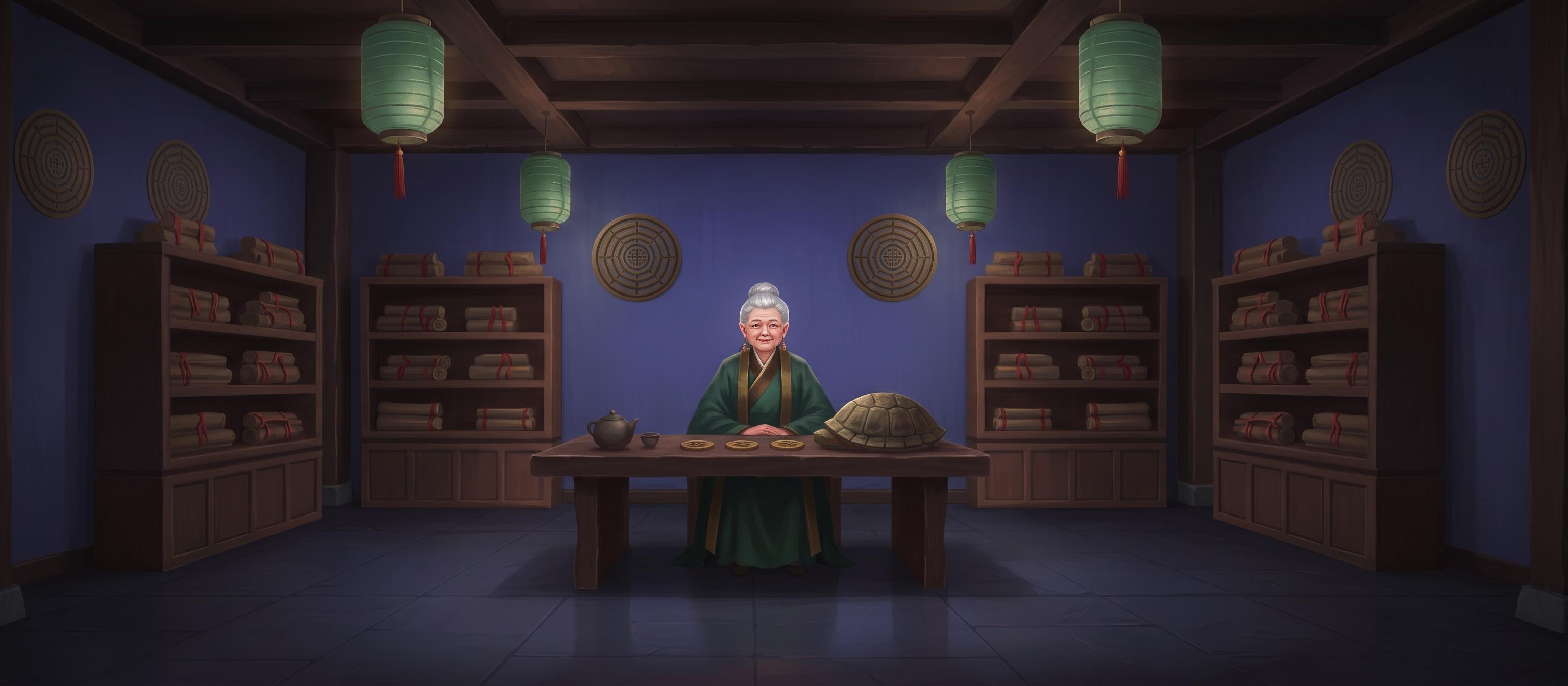
Ah, there you are — sit, sit. I'm Granny Zhou. Keep one question in mind, and toss these three coins six times.
Plum Blossom Numerology needs no coins: the hexagram is cast from the moment you ask (or from two numbers you pick at random), then read through how the Self and Matter trigrams support or restrain each other.
About
What is Plum Blossom Numerology?
Plum Blossom Numerology (梅花易数, Mei Hua Yi Shu) is a way of consulting the I Ching that is credited to the Song dynasty scholar Shao Yong. The story goes that he saw two sparrows fighting on a plum branch and cast a hexagram from the time of that moment. The method kept the name: instead of tossing coins, you turn a moment or a pair of numbers into two trigrams and a moving line.
Its distinctive feature is the reading of Ti and Yong. Ti (体, “self”) is the trigram without the moving line and stands for you, or the asker. Yong (用, “use”) is the trigram with the moving line and stands for the matter. Each trigram has an element, and how those two elements relate (does the matter feed you, drain you, or press on you?) gives a quick, clear direction. Three hexagrams fill in the story: the primary for the start, the nuclear for the middle, the changed for the outcome.
In the I Ching Studio you can cast by this moment, using the current date and hour in the Chinese lunar calendar, or by giving two whole numbers from 1 to 9999. The hexagram is fixed instantly, the 3D table lights up its six lines, and the AI explains the result in plain English around your question. It is offered for entertainment and self-reflection.
Reading the result
How a Plum Blossom hexagram is cast and read
The arithmetic is simple and fully shown. Here is what happens and how to read it.
- Casting by numbers
- The first number divided by 8 gives the upper trigram (remainder 1 Qian, 2 Dui, 3 Li, 4 Zhen, 5 Xun, 6 Kan, 7 Gen, 8 or 0 Kun). The second number gives the lower trigram the same way. Their sum divided by 6 gives the moving line.
- Casting by time
- The year's Earthly Branch number plus the lunar month and day gives the upper trigram; adding the hour's branch number gives the lower trigram and the moving line. The moment is converted to the Chinese calendar using the local time where you are.
- Ti and Yong
- There is always exactly one moving line. The trigram that contains it is Yong, the matter; the other is Ti, yourself. Read the question from Ti's point of view.
- The five relationships
- Yong feeds Ti: help comes to you, a good sign. Ti and Yong the same element: things go smoothly together. Ti controls Yong: you can manage it, with effort. Ti feeds Yong: you spend energy on it. Yong controls Ti: pressure on you, go carefully.
- Primary, nuclear and changed
- The primary hexagram is the beginning. The nuclear hexagram (互卦), made from lines two to four and three to five, shows what is happening inside the situation. The changed hexagram, with the moving line flipped, shows where it ends up.
- Plum Blossom versus coins
- Coins build the hexagram line by line and can give several moving lines. Plum Blossom gives one moving line and reads it through Ti and Yong, which tends to give a quicker, more direct answer.
What is different here
What makes our Plum Blossom tool different
Nothing is hidden. The panel shows the trigrams, the moving line, which trigram is Ti and which is Yong, their elements and the relationship between them, so you can follow the reasoning. The same formulas run on our server, which recalculates the cast before the AI sees it.
It sits beside the coin method in the same studio. Try both on one question if you like, and look up any of the three hexagrams on our page of all 64. The AI explains the result you got and is told not to change it.
Related readings
Related
The coin method, the hexagrams, and the elements behind Ti and Yong.
Is Plum Blossom Numerology free here?
Yes. Casting and the short reading are free within a daily allowance: guests get a few each day, signing in gives you more, and members get more again by tier. A full reading with follow-up questions uses points.
Should I cast by time or by numbers?
By time if the question has just come up and you want to capture the moment. By numbers if you'd rather choose: say the first two numbers that come to mind, or numbers connected to the matter.
Which time zone is used for casting by time?
Your own. The site reads your device's time zone and converts that local moment into the lunar month, day and the twelve two-hour periods of the Chinese calendar. Someone in New York and someone in Tokyo pressing the button at the same instant may get different hexagrams, because their local hours differ.
What are Ti and Yong?
Ti is the trigram without the moving line and represents you; Yong is the trigram with it and represents the matter. Their elements, and whether one feeds or restrains the other, are the heart of the reading.
What is the nuclear hexagram?
A hexagram built from the inner lines of the primary one (lines 2, 3, 4 below and 3, 4, 5 above). It describes the hidden middle stage of the situation.
Can I get more than one moving line?
No. Plum Blossom always gives exactly one, which is what makes the Ti and Yong reading possible. For several moving lines, use the coin method.
Is it accurate?
The casting follows fixed traditional arithmetic, so the same input always gives the same hexagram. What it means for your situation is interpretation, for entertainment and self-exploration.
Is Plum Blossom Numerology related to numerology in the West?
Only in name. Western numerology reads the meanings of numbers themselves; Plum Blossom uses numbers only to select trigrams and a line from the I Ching.
Other shops in town