Zi Wei Pavilion
Free Zi Wei Dou Shu Calculator: Your Purple Star Chart
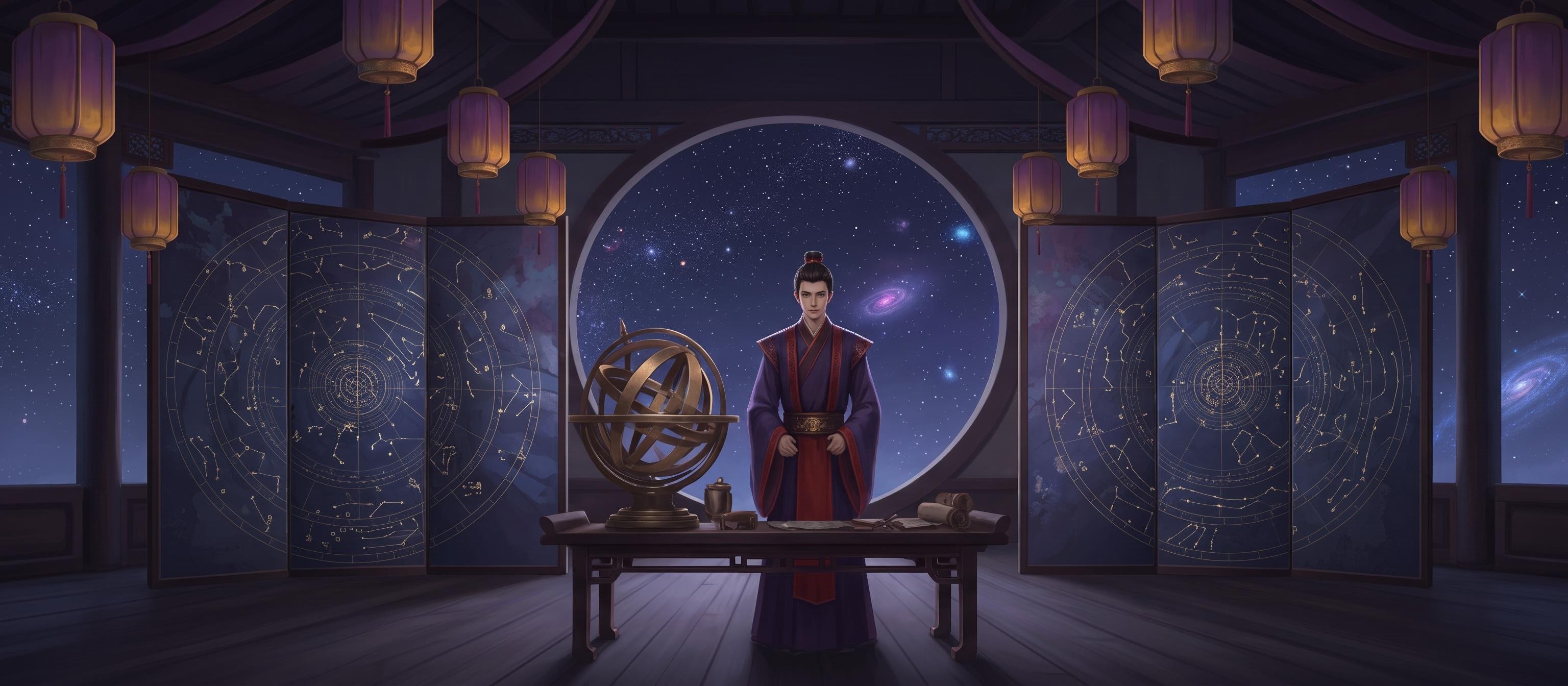
Please, sit. I am Mo Yan. Tell me when you were born, and I'll lay out the stars across your twelve palaces, one by one.
About
What is Zi Wei Dou Shu?
Zi Wei Dou Shu (紫微斗数), often called Purple Star Astrology in English, is a Chinese system of chart reading that took shape around the Song dynasty. It is named after Zi Wei, the Purple Star, which Chinese astronomers associated with the pole star. Despite the name, it uses no telescope: the “stars” are placed by calculation from your lunar birth date and birth hour.
A Zi Wei chart is a ring of twelve palaces (gong), each standing for one area of life: yourself, siblings, partner, children, money, health, travel, friends, career, property, inner life and parents. About a hundred stars are distributed across them. The fourteen major stars, such as Zi Wei, Tian Ji, Tai Yang and Qi Sha, carry most of the meaning; where they land, how bright they are and which of them are transformed shapes the reading.
Compared with BaZi, which reads the balance of the Five Elements in eight characters, Zi Wei Dou Shu is more pictorial. You can point at a palace and ask “what does my career look like?” and read the stars sitting there. Many people use the two side by side.
The Zi Wei Pavilion casts charts with iztro, an open-source library that follows the common Chinese school of star placement. You give your Gregorian birth date, time and gender; the chart is drawn on your device, recalculated on our server, and only then explained by AI. It is meant for entertainment and self-reflection.
Reading the result
How to read a Zi Wei Dou Shu chart
Star names are shown in pinyin on the chart. These are the pieces worth knowing first.
- Life Palace (命宫)
- The highlighted palace, and the starting point of every reading. Its major stars describe your basic temperament. The result title lists them, and on the chart they link to the star reference page.
- The twelve palaces
- Counting from the Life Palace: Siblings, Spouse, Children, Wealth, Health, Travel, Friends, Career, Property, Mind (or Fortune) and Parents. Each palace is fixed to one Earthly Branch around the square.
- The fourteen major stars
- Zi Wei, Tian Ji, Tai Yang, Wu Qu, Tian Tong, Lian Zhen, Tian Fu, Tai Yin, Tan Lang, Ju Men, Tian Xiang, Tian Liang, Qi Sha and Po Jun. Each has a character: Qi Sha is bold and decisive, Tian Tong easygoing, Ju Men sharp-tongued and analytical.
- Star brightness
- The small mark after a star (such as Prosperous, Favorable, Beneficial, Fallen) says how strong it is in that palace, from fully at home to out of place. A bright star expresses its good side more easily.
- Four Transformations (四化)
- Your birth year turns four stars into Hua Lu (abundance), Hua Quan (authority), Hua Ke (reputation) and Hua Ji (obstacles). They are marked next to the star and show where life tends to flow easily and where it snags.
- Empty palaces
- A palace with no major star is not empty of meaning. It is read by “borrowing” the stars of the palace opposite, and its minor stars still count.
- Decades (大限)
- Each palace carries an age range, such as Ages 4–13. As you move through life, a different palace takes its turn as the main stage for ten years.
- Five Elements bureau, Life and Body rulers
- The centre of the chart shows your bureau (such as Water 2 or Fire 6), which sets where the decades begin, plus your Life Ruler and Body Ruler stars. The palace marked “Body” is the one that matters more as you get older.
What is different here
What makes the Zi Wei Pavilion different
You see the whole chart, not just a summary. The result is the full twelve-palace grid with every major and minor star, brightness, transformations and decade ranges, so you or anyone who reads Zi Wei can check it. It is drawn in the traditional square layout.
The chart is calculated first and fixed. We use a published open-source engine, recalculate on the server, and send the AI only that finished chart, with the instruction not to alter it. The AI explains in plain English what the stars in each palace suggest.
It sits next to the other Chinese arts. You can cast your BaZi in the Hall of Fate across the square, compare charts with a partner through the Zi Wei compatibility reading, and save birth details for family and friends so you don't retype them.
Related readings
Keep exploring
Compatibility, star references and a beginner's guide.
- Zi Wei Dou Shu compatibilityCompare two Purple Star charts, palace by palace.
- The fourteen major starsWhat each star means in the Life Palace and elsewhere.
- BaZi calculatorThe other great Chinese birth chart: Four Pillars and the Five Elements.
- Guide: Zi Wei Dou Shu basicsThe twelve palaces and major stars, explained for beginners.
Is this Zi Wei Dou Shu calculator free?
Yes. The full chart is free, and so is the short reading, within a daily allowance: guests get a few each day, signing in gives you more, and members get more again by tier. Full readings, topic reports and compatibility use points.
What is the difference between Zi Wei Dou Shu and BaZi?
Both start from your birth moment. BaZi turns it into eight characters and reads the balance of the Five Elements. Zi Wei Dou Shu places around a hundred stars into twelve life areas and reads what sits where. BaZi is often called better for overall strength and timing, Zi Wei for detailed life areas.
Which star is in my Life Palace?
Cast your chart and look at the highlighted palace, or at the title of the result panel, which lists its major stars. If it says “Empty palace”, the Life Palace has no major star and is read through the opposite palace.
Why are the star names in pinyin?
There is no single agreed English translation for most stars, so the chart keeps the Chinese names in pinyin, as most practitioners do. The reading and the star reference page give their meaning in English.
What if I don't know my birth time?
The chart is cast for the noon hour. In Zi Wei Dou Shu the hour decides where the Life Palace sits, so an unknown hour changes a lot. Treat the result as a sketch, or ask family for the hour first.
Do you use true solar time or ask for my city?
No. The chart uses the clock time you enter as it is. If you were born close to the start of a two-hour block, try the neighbouring hour too.
Which school of Zi Wei Dou Shu do you follow?
The calculation follows the widely used Chinese placement rules as implemented in the iztro library. Regional schools (for example Vietnamese Tu Vi) place some minor stars differently, so other charts may differ in the details.
Is Zi Wei Dou Shu accurate?
The chart is produced by fixed rules, so it is consistent. Meaning comes from interpretation, which here is written by AI. Use it to reflect on yourself, for entertainment and self-exploration, rather than as a forecast.
What do the paid readings cover?
The full reading covers overview, career, love and advice for now. Topic reports focus on career, love, wealth or the year ahead. Compatibility compares your chart with another person's. Every paid reading allows up to 20 follow-up questions.
Who is Mo Yan?
Mo Yan is the young star reader who keeps the Zi Wei Pavilion in FateTown. The chart is calculated by software and the interpretation is written by AI. There are no live consultations.
Other shops in town